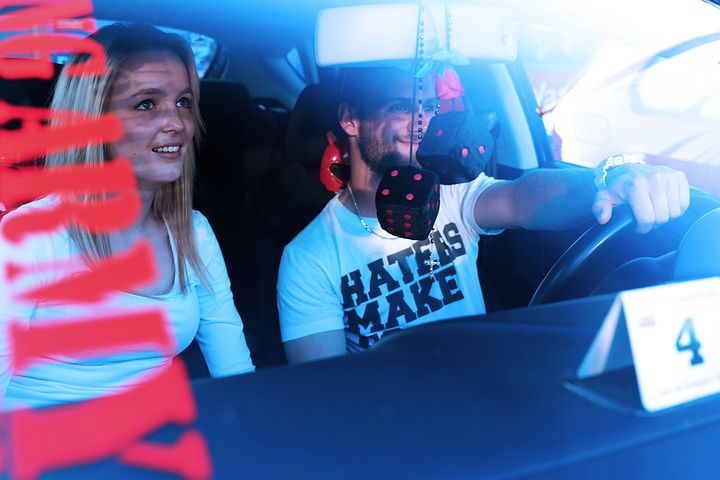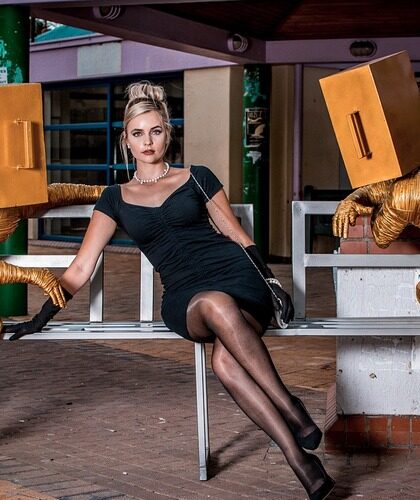
Our volunteers received a lot of positive feedback during their trip to the ’09 San Diego Comic-Con. One thing that got a lot of attention: the street team shirts! This way you can support the movement and spread the word in style:
We are very excited to announce that our official shirts are now available at BlackLava.com. BlackLava is well-known in the Asian-American community. They are the official vendor for Angry Asian Man, 18 Mighty Mountain Warriors, Secret Asian Man, and many other big organizations.
Because of BlackLava’s close relationship with Asian-American causes, Racebending receives a full 100% of proceeds from all shirt sales. Funds are needed to maintain the web-site, purchase booth space at conventions, promotional material for distribution (fliers and flair), and further shirt printings.
Now you can support Racebending and look great doing it!
Shirts are $14.95 and come in Women’s sizes and Unisex sizes. Shirts are from fair-trade manufacturer American Apparel. Order yours today!
Well, Hollywood does it again, this time by casting Italian American Disney channel darling David Henrie to play–get this–an Asian American character named Tommy Zhou. Platinum Studios is making a film adaption of their comic book series The Weapon.
The filmmakers are emphasizing Henrie’s martial arts experience while de-emphasizing the fact that the character he plays is Asian American. This is again another example of Hollywood sending the message that white actors are more qualified to portray Asian characters than Asian American actors are.
The Weapon is written by comic book author Fred Van Lente, who is well known for helping popularize another Asian American comic book hero, Marvel’s Amadeus Cho. Amadeus, Jubilee, and Tommy Zhou are some of the very few Asian American comic book heroes in existence.
And the story of the The Weapon takes it a step further–at it’s heart it’s about an Asian American kid trying to reconcile his Chinese and American heritage. Throughout the story Tommy struggles with being American, yet Asian. At the end of the story Tommy recognizes that both the Asian and American parts of himself deserve respect, coming to the realization that he “must embrace the good in both parts.”
This is not an indictment against the acting skills of Mr. Henrie. Our concern is not that they have given Mr. Henrie a leading role, but that he has been chosen represent an Asian American while real-life Asian Americans are still systematically denied leading roles in films. Since the Asian American identity of Tommy Zhou is unambiguous, undeniable, and intrinsically part of his story this is one of the worst cases of whitewashed casting in recent memory.
Racebending.com wrote a letter to Platinum Studios Executive Producer Randy Greenberg on September 21st, but we have not received a response. The Media Action Network for Asian Americans has also sent a letter through certified mail and is waiting for a response. We are now calling upon members of the racebending.com community and general public to email, call, and write to Platinum Studios. Letters can be sent to the following emails and addresses. Racebending.com’s sample letter can be viewed below (feel free to borrow from it in your own letter.)
Platinum Studios, Inc.
11400 West Olympic Blvd, 14th Floor
Los Angeles, CA 90064
(310) 807-8100
September 21st, 2009
Dear Mr. Greenberg;
We are a coalition of fans dedicated to monitoring culturally insensitive casting in Hollywood. I am writing to protest the culturally insensitive casting of your film adaptation, “The Weapon.” It is our hope that Platinum Studios reconsiders the casting of David Henrie to portray Tommy Zhou.
We would gladly publicize and support a film that both accurately depicts the character of Tommy Zhou and brings new minority talent to the forefront. If your studio is interested in making a film with Mr. Henrie, Platinum Studios can still do so—without using discriminatory casting practices that will draw public scrutiny. Cast him in a role that does not require him to participate in the modern-day equivalent of “yellowface.”
But if the intent is to create a live-action film adaptation of The Weapon, we are respectfully asking that your studio please have the decency to cast an Asian American actor to portray Tommy Zhou’s story. We are prepared to protest the casting of this film alongside other advocacy groups if your studio decides to move forward with this casting decision, though we hope you will reconsider.
One of Platinum Studios’s core value is social responsibility, yet your film has taken an Asian American lead character and cast him as white. Denying actors of color the role of a lead character of color in this film—even going so far as to downplay the significance and change the ethnicity of a clearly Asian American character—is not socially responsible. You are sending the message that a white actors are more entitled and qualified to portray an Asian American hero, than Asian American actors are.
Employing this kind of discriminatory casting will negatively impact your studio’s reputation, when The Weapon should be a film that popularizes Platinum Studios and brings new fans to your properties. Casting an Asian American to depict Tommy Zhou is more conducive to The Weapon’s long-term economic prospects and legacy, as films with culturally insensitive casting are falling out of public favor. The casting of actor David Henrie to play Asian American character Tommy Zhou is discriminatory against Asian American actors, and offensive to viewers of all ethnicities.
I look forward to continuing a dialogue with you on this matter and am confident that we can find common ground, especially given Platinum Studios’s dedication to social responsibility.
Sincerely,
Marissa Lee
Coordinator
mlee@racebending.com
www.racebending.com
It goes without saying, be polite, but assertive and firm in your convictions.
Good luck everyone! Feel free to share your letter in the comments.
Dariane has just finished the final cut of our interviews from San Diego Comic-Con 2009. Hear professionals and fans as they speak out against the casting and share their thoughts on the whitewashing of The Last Airbender.
Watch, listen, share.
Use this link to share: http://tr.im/rbsdcc
Special thanks to Gene Yang (author of American Born Chinese and Eternal Smile), Tycho Brahe (of Penny Arcade), Benton Jew (illustrator), Sandeep Parikh (of The Guild, creator of Legend of Neil), and Keith Chow (editor at large for Secret Identities).
Harvard University professor Michael D. Baran, Ph.D. is an expert on anthropological and psychological theories of how children learn about race. Racebending.com collected questions from readers and submitted them to Professor Baran via e-mail.
RACEBENDING.COM: What potential impact does the “whitewashing” of the heroes of The Last Airbender have on children in the audience?
PROFESSOR BARAN: It’s hard to speculate on the impact of these casting decisions. Certainly it would be worrisome if all the heroes in any film were white and the villains were minorities. For those who were already familiar with the TV series, it may send additional problematic messages about the suitability of minorities as heroes.
Because children are trying to figure out these complicated social categories, it is particularly important for producers and casting directors to pay close attention to these decisions and thoroughly think through potential impacts.
RACEBENDING.COM: How does the absence of heroes, fantasy figures, and role models of color impact the children watching? How important is it for kids to have heroes who “look like me”?
PROFESSOR BARAN: It is critical that children see all sorts of people playing both the good and the bad roles in media. Otherwise, they may take those absences as meaningful and it may affect how they understand social categories. And it is certainly important for kids to be able to identify with heroes that they feel represent who they are as people.
For very young kids, this might or might not fall out along racial lines and we must be careful not to impose our reification of race onto their knowledge. But we might as well err on the good side, by having a diversity of heroes for people to relate to – not just racially, but also in terms of gender, religion, body type, etc.
On August 21st, 2009, racebending.com staffer Dariane N. joined protesters from the Media Action Network for Asian Americans (MANAA) and the Japanese American Citizens League in front of the Paramount Pictures lot. (More coverage here and here.)
The group protested the film The Goods‘s use of racial humor through the depiction the beating of an Asian car salesperson. This scene in the movie was offensive to several Asian American groups not only for its cultural insensitivity and for using a hate crime for laughs, but because it was very similar to a previous controversial real-life hate crime–the Vincent Chin case that is to the Asian American community what the Rodney King case is to the African American community.
MANAA has posted the apology email the JACL received in response to their concerns and the protest. The letter can be viewed in its entirety, here.
“While this film is intended to be an extreme satirical comedy, it was never the objective of the producers or the studio to single out any one group for ridicule or to promote hurtful, racially disparaging language. We genuinely regret the use of this language in the film.”
“At Paramount, we would welcome a continuing dialogue over the next several weeks with you and other leaders of the Asian-American community. Again, on behalf of Paramount and Paramount Vantage, we hope you accept our sincerest apologies.”
Paramount has not offered Asian American actors very many meaningful opportunities this year. The ethnicity of the characters in The Last Airbender were changed, denying Asian American actors lead roles. The Goods is one of Paramount’s only films featuring an Asian American actor, and the role was not only minor, but also offensive.
Racebending.com hopes that continued dialogue between Asian American community leaders and Paramount Pictures will yield less discriminatory casting practices, more culturally sensitive films, and more opportunities for actors of color.
One of the ongoing projects at racebending.com is interviewing experts in various academic and professional fields about Hollywood’s discriminatory casting practices and the impact these practices have on our society. We hope that their perspectives can shed some light on why we believe fighting this form of discrimination is important.
Professor Russell K. Robinson is a law professor at UCLA, whose 2006 paper kicked up some dust in Hollywood trade magazines when it suggested that minority actors may have legal grounds to sue studios over their casting policies. Racebending.com staffers Dariane N. and Marissa L. interviewed him about the legality of “racebending,” why it happens, and how we can fight to stop it.
RACEBENDING.COM: Does casting white actors to play ethnically Asian characters violate equal opportunity employment laws? (re: Casting breakdowns requesting for “Caucasian or any other ethnicity.)
PROFESSOR ROBINSON: That’s an interesting question under Title VII—whether it actually violates a statute. I would argue yes—and people could contest this—because you’re supposedly hiring everyone, but mentioning one race. That is indicating a preference, and that is inequality…The Title VII case law is very clear in other contexts. You cannot say: “I am discriminating because it will help my business be more profitable.”
RACEBENDING.COM: If an argument can be made that Hollywood is breaking employment discrimination laws, why does it go unchecked?
PROFESSOR ROBINSON: It just shows that the practice doesn’t match up with the law. And I think it’s because people aren’t challenging it and I hope we’ll have actors that actually sue and take that risk.
“The challenge is to get people seeing this as a priority and people getting affected. People see it as entertainment, not as important, it’s only one industry—but one of the most influential industries.
“If you look at all the kids that watch films and TV, and don’t see themselves represented, it’s a concern we should take very seriously; not something that’s marginal. We can see Sasha and Malia in the White House, but we can’t see Asian kids playing the leads of this film.”
- Professor Russell K. Robinson, UCLA School of Law
We’re hoping to bring a new series of content and articles for readers of racebending.com, so if you have any ideas on who to interview next, any other kinds of articles, or if you’re interested in contributing, please feel free to contact us!
racebending.com was fortunate enough to get some free publicity at Dragon*Con over Labor Day weekend.
Thank you to Stephen Granade, who made the following video for DragonConTV. This racebending.com video was written for Dragon*ConTV 2009 by Stephen Granade. It was broadcast as part of the DragonCon CCTV during the convention.
“[...] This was a part of DragonCon TV which is played before panels and in the participating hotels though out Dragon Con. It repeats throughout the weekend, how many times I’m not sure but I know I saw some things more than once. The pics were taken on Sat. night at the costume contest (otherwise known as a reason to sit down). It seemed kind of random to me because outside of this board and the website I really have not seen much about it. Because of this I missed the first “slide” that basically said “Hey anyone fans of Avatar The Last Airbender? Did you know they are making a movie?”
While we applaud and support this video, racebending.com was not involved in the creation of this video. Mr Granade took the initiative and did it all independantly. We’re not the only people out there upset about the casting, Paramount!
Amazing turn out! And even more heartening, the protest worked – sort of. While the scene in The Goods will, at this point, remain in the movie, Paramount has said that they will withdraw the questionable scene (shades of the brutal murder of Vincent Chin) from all iterations of the trailer and promotional material.
According to the news report, Paramount has also said they will meet with Asian American leaders to talk about the questions in the movie. Maybe the Asian American leaders will also have a chance to discuss the casting of The Last Airbender with Paramount execs.
Thank you to all the protestors and of course to our allies MANAA – it’s because of you that change is happening!
ETA: The protest was a success! More here.
Well, Paramount Pictures has done it again.
From our friends at MANAA, we’ve recently learned that Paramount’s latest movie The Goods: Live Hard, Sell Hard features a scene in which the characters participate in a hate crime against an Asian American for laughs. Unsurprisingly, Asian-American groups (such as the JACL) are offended and up in arms.
The People Against Racebending will be joining JACL and MANAA in their protest on Friday in Los Angeles, CA.
What: Protesting “The Goods”
Where: right outside of Paramount Pictures on Melrose Ave, Los Angeles, CA
When: Friday, August 21, 2009, 4:30pm – 6ish pm
This is a good opportunity to show Paramount Pictures (as well as our allies, the JACL and MANAA) that we’re serious about fighting racism in Hollywood beyond TLA. Show up if you can make it and don’t go see the movie!
Here is the trailer to The Goods:
In it, you can clearly see the problematic scene. Here’s the Angry Asian Man‘s description of it:
The movie is about a notorious used car salesman who takes on a big Fourth of July sale. During the scene in question, Jeremy Piven fires up his fellow salesmen with a pep talk, invoking World War II: “Don’t get me started on Pearl Harbor. We are Americans and they are the enemy! Never again!”
The scene culminates with an angry mob beating up the only Asian American person in the room, Teddy Dang (played by Ken Jeong). Piven’s character also uses the racial slur “Jap” in the scene and, acknowledging it was a hate crime, conspires with employees to say that Dang was attacking them with a “samurai sword” and “Chinese throwing stars.”
While the scene is played for comedy, the threat of physical violence against Asian Americans is all too real. December 7, the day of the attacks on Pearl Harbor, is commonly dreaded by members of the Japanese American community and the wider Asian American community.
Lastly, we are told that the character is not even Japanese-American, but Korean-American. The film reveals this as if it makes everything ok. It doesn’t.
And if you can’t join us at the protest, we still need your help! Contact your local media (newspapers, websites, broadcast news, etc) and send them MANAA’s Press Release!
Since we now know what the actors will look like playing the characters, a new comparison image has been created.
Yes, Zuko is seen and portrayed as the enemy in Book 1 – which we assume will be covered in this first movie. Yes, we know he is eventually redeemed and he’s conflicted and we love him for it.
However, Paramount Pictures doesn’t give a damn what fans know about Zuko, because us fans won’t provide them with the main revenue. Their concern is hooking movie-goers who haven’t even heard about Avatar: The Last Airbender to see a movie about brave white-skinned heroes battling the angry dark-skinned enemies.